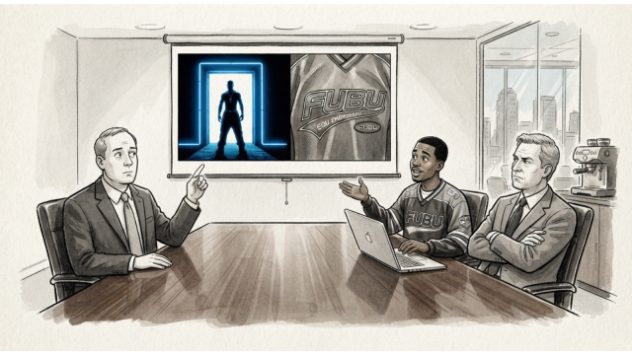
the recommendation
When Viacom acquired BET, it paid $2.34 billion for the asset. Before leaving the company, Scott Mills was in the middle of leading negotiations to sell the asset for a rumored $1.7 billion. It was rumored that Tyler Perry Studios offered $2 billion for BET, and Viacom turned down the offer, remaining firm on an asking price of $3 billion. Back of the envelope math tells you that $2.3 billion in 2001 should look more like $4 billion in 2026. Perhaps this discrepancy reflects larger trends in television, and less about the inherent value of the asset itself. At one point, Byron Allen submitted a bid of $3.5 billion, but folded VH1 into his offer. I say all this to paint a picture of the marketplace’s value of BET as a brand today.
Byron Allen’s acquisition of The Weather Channel for $300 million along with Byron Allen’s $120 million acquisition of BuzzFeed, and his recent stake in Starz, means one can expect that Allen will likely emerge as the likely candidate to take over BET. There’s an ethos there. While the town waits for Paramount (the old Viacom) to swallow Warner Bros. Discovery, it’s likely the ownership of BET will remain a matter decided for another day. Still, there are other portfolio opportunities for buyers seeking to capitalize on a brand’s cultural authority.
I had an old mentor in a prior life who would receive a download of information before quickly asking you, ‘So what’s your recommendation?’ One of the best questions ever. So let’s, if you will allow me, surmise upon a recommendation today.
FUBU The Collection, LLC (For Us, By Us) represents one of the most significant success stories in the history of Black-owned businesses, transitioning from a grassroots hat company into a global fashion empire that defined 1990s streetwear. I’ve written, very briefly, about FUBU in the past. Today, let’s seriously consider what FUBU, reinvented for the 21st century, looks like.
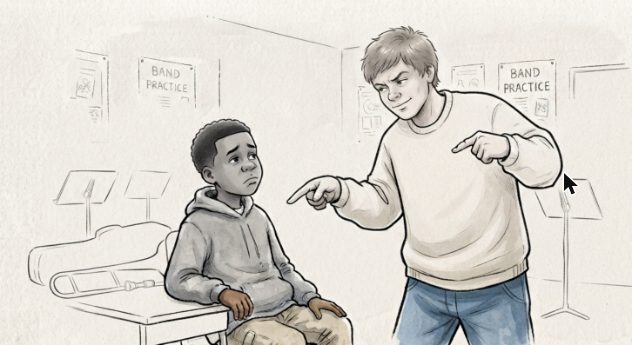
My personal attachment to FUBU. While attending a private Christian school, I was bullied by an older kid during band class. My family, being the upstanding immigrants they are, resisted brand names when shopping. My mom’s idea of a brand name was Lands’ End, because my school chose Lands’ End as the vendor for the school uniforms. Some years, my mom resisted the price for these uniforms by successfully replicating the logo of the school by sewing it into some non-Lands’ End polos herself. My mom is an incredible woman.
Clothes mean a lot to kids. Even with uniforms there remains the accoutrements of hoodies, jackets, sneakers, and bomber jackets. When the bully set his sights on me, he asked me, “What are you wearing? FUBU?” before chortling an evil little laugh. At thirty one, this memory has been burned into my skull. And it was the first time I ever heard about the brand: FUBU.
Damn, Daniel.
When I asked my Trinidadian mom, later, what FUBU was, she explained it to me this way: “That’s LL Cool J and ’em. One of dem fashion designers was being racist and didn’t want the rappers wearing their clothes. But dem rappers is what makes people want to wear dey clothes anyway. So dey just made dey own thing. ‘For us, by us’ is what it means.”
As I type this, revisiting both the story of being bullied and having “FUBU” used as a taunt, and then my mother explaining to me the meaning of the taunt, makes me emotional. Recasting black entrepreneurship to insult and dehumanize the entrepreneurs is a tale as old as time. And the result…some folks resist certain fruits in certain rooms, after all. It’s heartbreaking that our kids have to absorb culture this way, but such tears will pour down in another essay. We have capitalism to opine upon because we have a recommendation to surmise upon. So chop chop.
Living in the center of the entertainment industry means I’ve been blessed to be surrounded by rebels, they remind me that emotional brand identities are still mostly tools of commerce. But as Christopher Nolan explained, the real problem with criticism today is that identifying the mechanism still fails to invalidate it.
I am emotionally attached to what FUBU means, and this attachment goes far beyond any design identity that it’s ever promoted. Robert L. Johnson’s rich legacy deserves all the attention it’s received; but Daymond John’s brand speaks to something else deeper, more emotional, more honest, and more true to “the culture.”
FUBU as an acquisitions priority
FUBU today is a licensing business.
The mark is privately held by its four founders and monetized through administered by an outside agent, The Brand Liaison. The current structure includes a variety of partners around the world: Snipes in Europe, Samsung (China) Investment Co., Ltd. China and Korea, Acros Pvt. Ltd. and Mastermind in Japan, and Versalicensing Lifestyle Brands in Mexico. Announcing the Japan and Mexico deals in 2025, Daymond John described international licensing as a strong pillar of FUBU’s business, which is accurate and also tells you where the business lives.
The company reported roughly $350 million in annual sales by 1998 and is generally cited above $6 billion cumulatively. What it earns now is not public and I could not find it. For context about other brands from this era, nearly every comparable mark from the same era was sold into a brand management platform. ICONIX bought Rocawear Corporate in 2007, 51 percent of the Ecko portfolio in 2009 for a reported $109 million, and Zoo York LLC alongside it. All three sit in that portfolio. FUBU does not, which means it was never for sale, never bid on, or bid on and declined, and which of the three precedes every other question in this essay. Every comparable mark from that era found its buyer 18 years ago, which perhaps means the buyer has to be assembled rather than found.
the film license, and what it tells you
So let’s talk about the FUBU film license in particular. In May 2024, Pantheum Studios, a subsidiary of Euldora Financial, announced a $450 million, thirty picture partnership with an entity called For Us By Us Studios, for over three years.
Read that announcement the way an acquisitions executive reads it, which is to say read the distribution of the news rather than the news. It went out over PRNewswire and was picked up by Essence Magazine, Black Enterprise Magazine, and a spread of aggregators and culture sites. I could not find coverage in Deadline Hollywood, Variety, or The Hollywood Reporter. A genuine $450 million three year commitment is one of the larger independent financing events of any given year and it belongs on the front of a trade. When a number that size travels through the wire and the culture press but not through the trades, that is the market telling you something about the counterparty that even I won’t articulate in text.
A press release costs about eight hundred dollars and a term sheet costs a lawyer. Benjamin Graham said the market is a manic depressive business partner. He did not anticipate that the mood swings would become available for purchase at wire service rates.
Let’s keep going. The pattern around it is consistent. That same group, Pantheum Studios, announced a $150 million, fifteen picture deal with Santi Films twelve days after the FUBU announcement, and a $400 million, five year deal with Black Deer Entertainment in September, the latter dated out of Burry Port, Wales with a forthcoming 150 acre New Jersey facility attached. Over a billion dollars of stated commitment in four months from a group that had not previously appeared in anyone’s deal flow. Two years later, no one can trace a completed picture to any of the three slates.
why that deal was structured to fail
Set aside the counterparty and grant the money. The deal still fails on its own terms. Thirty pictures at $450 million is a fifteen million dollar average with no line anywhere in the announcement. So either the real budgets are eight or nine million with marketing folded in, or the slate was always headed to a streamer at a flat license, where the economics are and there is no to argue about. Either way, the headline number is doing work the structure cannot support. Second, thirty pictures in three years is a studio’s annual output rate, and studios sustain it with physical production infrastructure, tax credit apparatus, completion bonding relationships, and a distribution answer decided before greenlight. The announcement contained a great many titles but nobody who had run that machinery. Third: FUBU took no position in what the pictures were. It licensed its name onto a slate defined by someone else’s development taste, with no stated relationship between what appeared on screen and what FUBU sells. Thirty films could have been produced and the apparel business would likely have been unaffected by every single one of them.
the left hand and the right hand
A brand with real cultural equity that is licensed rather than managed becomes a set of unconnected revenue lines. A European apparel licensee optimizes for European apparel. A Japanese licensee optimizes for Japanese specialty retail. A partner optimizes for channel carriage. A film licensee optimizes for a film slate. Every one of them is behaving rationally, and no two of them are pointed at the same objective, because nobody owns the objective.
Cinedigm Networks announced the For Us By Us Network with J. Alexander Martin (Dr. (honoris causa) in March 2023, on the stated premise that only thirty four served Black audiences, roughly two percent of the total. That is a genuinely valuable asset. In a managed company it would be the distribution arm of a merchandise business. In a licensed company it is a channel that has no obligation to sell anything, sitting alongside a film deal that has no obligation to dress anyone, alongside apparel licensees who will never see either.
This explains why there is currently less in FUBU than there should be. is not the sum of royalty streams. It is what the streams do to each other. , and typically a buyer pays a multiple for multiplication. Time does all the heavy lifting. There is a version of every heritage mark that ends its life on a folding table at a highway outlet, and it happens the way weight gain happens, one entirely defensible renewal at a time.
In business, a distributor is most valuable when they already have an audience, and we have treated the absence of particular types of distributors as a fact about the world rather than a vacancy somebody could be paid to fill. But it is merely a vacancy. FUBU could fill an enormous gap in the marketplace. And what could that look like? Let’s get into it.
The first step would be for a capitalized entity, with a patience for building durable projects (a Family Office) to acquire a majority control of FUBU and finance it against FUBU’s current licensing book. Trademark royalty streams are and HarbourView’s growing catalog business provides an analogous deal structure if one swapped out the music revenue business for the fashion business. Fashion houses packaged royalty rights into off-balance-sheet vehicles in the late nineties, and the whole business securitization market that grew out of franchising now routinely takes trademarks and license agreements as collateral through .
The template already exists. In 2025 Iconix took majority ownership of the British streetwear brand Hoodrich with the founder retaining an interest, a separate operating partner running the business, and a retail partner attached. Founders say yes to that more often than to a clean sale, because it is a .
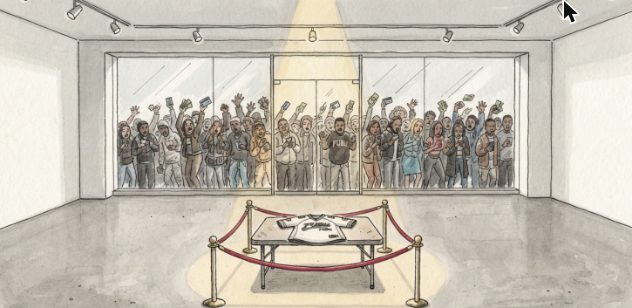
FUBU’s entrypoint into the media landscape should coincide with the announcement of high profile partnerships. FUBU needs to run prestige collaborations to reset the price ceiling. The Adidas playbook, where collaborations were launched with Fear of God, Cactus Jack, Fenty, Ivy Park, and Lord Voldemort. This is how legacy brands reset their price ceiling. A music catalog decays. Streams of a 1998 record decline on a predictable curve as the cohort that loved it ages, and the underwriting is essentially actuarial. Fashion IP does not behave that way. It does not decay, it rusts in place. The mark stops being worn because it was distributed into contempt, not because anyone stopped recognizing it, and recognition is the expensive part. Then, if something catalyzes it, it compounds non-linearly, because the recognition was never lost, only the willingness to be seen in it.
Which means uncoolness is not depreciation. It is . A mark that has gone cold has been cleared of competing associations, and that is a far better starting position than a mark with the wrong associations, and an infinitely better one than a new label with none at all. You are buying recognition at a discount created by embarrassment. The rehabilitation mechanism follows directly, and it is counterintuitive enough that no licensor will ever do it voluntarily: you starve distribution and terminate the off-price and discount channel to decline the volume, and you deliberately make the product hard to get. That is the only way to restore pricing power, and it works because .
Starving distribution is a big ask. A licensing owner will never do this, because a licensing owner’s entire income is the volume being cut. Only a control owner with patient capital and a debt structure sized for the trough can execute it. At the same time, this is the very reason the opportunity exists.
Today, when a bully asks, “Are you wearing FUBU?,” his reasons for the ridicule are new.
Every consultant who has ever looked at this brand has produced the same recommendation, which is to grow distribution, because growing distribution is what you say when you are being paid to say something and will not be there in year four. The correct advice is to shrink on purpose, which is not advice anyone gets hired twice for giving.
the license book and the drop
There are two key ways a mark like this earns, and they differ less in revenue than in margin structure and working capital.
The first is the license book as it exists today. The owner’s cost of revenue is close to zero and so is the owner’s control. This is a clean, boring, bankable stream.
The second is owned direct-to-consumer. Gross margins on premium apparel sold direct run far above wholesale royalty economics, but the conventional objection is working capital: you buy fabric, cut, hold inventory, and then discover whether anyone wanted it. The drop model answers this. A pre-order or made-to-order capsule inverts the . The customer pays before the factory does. A brand running limited drops on that structure operates on , which means growth consumes no cash.
So the arithmetic of the whole vehicle is roughly this. The change in enterprise value is the change in . Everything upstream, like producing films for instance, is an input to that single rate variable. The film cannot be treated as a profit center and should never be modeled as one. It is merely an input to a rate that gets capitalized.
So film could be a critical tool to reinventing FUBU for a new generation. There are some other experiments that could be made with its distribution. It would be exciting for FUBU to use Instagram as its , allowing for non-exclusive, time-limited, free, ad-supported releases that are timed to land in the eight to twelve weeks the capsule is on sale. Given Instagram’s growing sales tools, this could be lucrative for FUBU, but also a meaningful contribution to the e-commerce war between Tiktok and Instagram that shows no signs of slowing. Every window a film has ever had puts the viewer somewhere the merchandise is not. Theatrical, home video, pay-one, subscription, free ad-supported; in all of them the person looking at the coat and the place the coat is sold are separated by a car ride and a season. The entire apparatus of product placement exists to close that gap and does not close it, which is why placement is priced as a novelty and behaves like one. Amazon has experimented with this in the past. A social television app is the first window in which the audience is already standing inside the store. In this arrangement, FUBU’s content would live on Instagram’s streaming platform before it emerges a conventional streamer license, sold afterward, at a price.
Instagram has never licensed a feature. The television app is months old, and there is no acquisitions desk to call. This is a window that has to be argued into existence rather than booked, which means the argument for FUBU as a media entity has to survive without this feature of the argument, and any practical reality for this feature of the argument must just be treated as upside.
A free window is supposed to destroy the behind it. Ordinarily it does. It does not here, for three reasons worth separating. A new “Instagram window” is short and non-exclusive, so nothing has been alienated in perpetuity. The person who watched a free ad-supported film on a social surface is not reliably the same person who pays for a subscription, which is the assumption the entire orthodoxy rests on.
FUBU in the 21st century
So rather than committing to a half a billion dollar slate, the strategy should be for FUBU to commit, first, to one picture inside its own cultural window. If we think a bit critically here, thirty pictures produced in such a small time frame will likely produce thirty small conversations that sum to nothing. FUBU can buy a library through , filtered on merchandise fit. There should be three intake lanes for FUBU: finished films, films in post, and packaged projects in development. Committing at the puts FUBU in more of the rooms that currently drive culture. What the room buys is authorship. There is a difference between a brand that appears in a film and a brand the film is dressed in. On finished and in-post productions, acquiring an orphaned independent keeps distribution channels fed and holds the calendar while a tentpole is in production.
The criteria should be narrow: FUBU should commit to remaking a title from the years when its brand and “the culture” were the same thing, where the clothes are part of why people remember it, castable with new talent rather than dependent on a reunion, and with reachable rights. Boomerang is the right register of what we’re looking for but the wrong example, as it’s a Paramount asset with living participants and an enormous price. The reachable version is a title dormant in a library nobody has been assigned to, or held by an estate or a producer waiting twenty years for a call. I’ve previously made a case for — a structure where the studio licenses a dormant title out, takes no distribution obligation, deploys no capital, holds a backend participation, and gets an asset serviced it was never going to service.
You have to be careful about which films you remake, and how you remake it. Consider House Party, 2023. New Line and LeBron James’s SpringHill, the Hudlin brothers executive producing, a celebrated music video director debuting. It grossed $9.3 million worldwide. The 1990 original made $26.4 million (almost $70 million in today’s dollars).
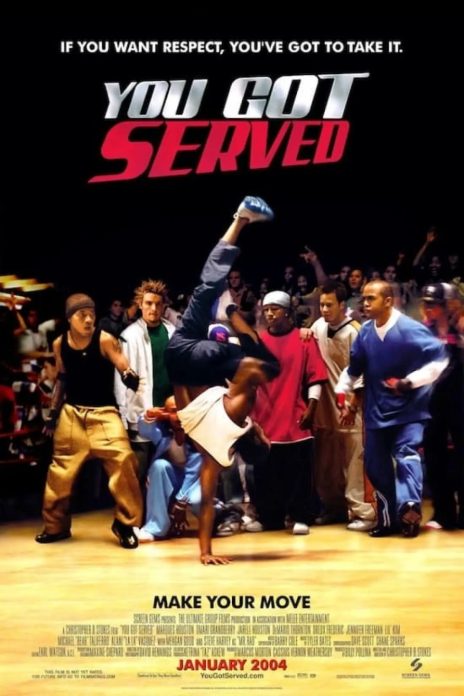
For FUBU, a strong candidate would be a remake of Sony’s You Got Served. The rights sit at Sony, dormant. A sequel was announced seven years ago and did not get made, which is the precise condition the sidecar addresses: a title with proven economics that nobody inside the building has been assigned to.
During my time at Sony, Christianne Cruz put three things on my radar: the undervalued economic potential of the Filipino diaspora, the dearth of the dance film, and who is Hollywood’s next Jon M. Chu. Obviously, she is a brilliant woman.
Sony Pictures Entertainment’s division, Screen Gems released You Got Served on Super Bowl weekend 2004. It opened number one, carries a 14 percent critical score, and grossed $50.6 million worldwide against an $8 million budget. Every criterion this essay set is met, and one it did not anticipate.
It is wardrobe-forward by genre rather than by accident. A dance film is ninety minutes of bodies in clothes, moving, shot to be looked at. Costume is not set dressing in that genre, it is the subject, which makes it the single best use case for committing at . Every other candidate title requires an argument for why the clothes matter. This one requires an argument for why they would not.
The economic objection to a tentpole is that failure has to be survivable, and dance films are the genre where the original was made for eight million and returned six times that. House Party 2023 failed at a budget that required a wide theatrical to work. This is a form that has never needed one.
Now, the marketing problem solves itself.
Dance is the native grammar of vertical video. A dance film generates shareable content as a byproduct of production rather than as a spend layered on top: choreography is content, the choreography is the film, and the audience reproduces it for free wearing whatever it was shot in. The dance film is the sole format in which the audience performs the marketing for free, uploads it themselves, and then writes to thank you for the opportunity. Every other category of consumer business spends the back half of its budget trying to manufacture that behavior and gets influencer contracts instead. In this genre, the picture, the campaign, and the merchandise catalogue are the same asset, and it is the reason the second window described above is not a nice-to-have on this particular title but the entire distribution plan.
the case for Keone and Mari
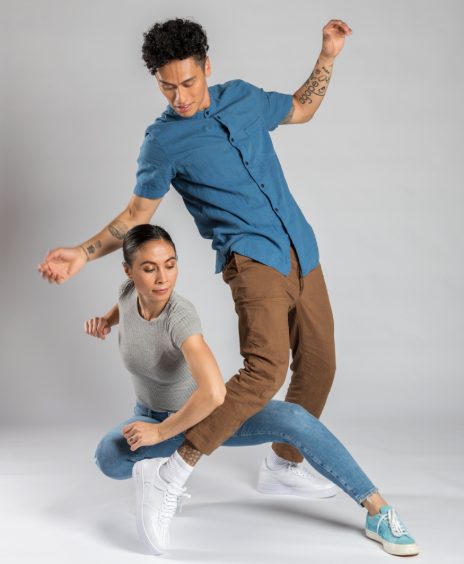
If this essay persuades a reader of one thing, let it be this. Hollywood’s next Jon M. Chu is a married couple from San Diego, and the industry has been looking straight at them for a decade without seeing it.
Read their work as a director’s reel rather than a choreographer’s.
Keone and Mari Madrid choreographed and starred in Justin Bieber’s Love Yourself, a video with more than 1.6 billion views. They are longtime choreographers for BTS, including Dope, Blood Sweat & Tears, and DNA. They were nominated for an MTV VMA for their choreography on Flying Lotus and Kendrick Lamar’s Never Catch Me. Their online work runs to billions of views.
They co-created, directed, and choreographed Beyond Babel, an Off-Broadway dance-theater piece that told a full Romeo and Juliet narrative through movement, with no dialogue carrying the plot. It was a New York Times pick and drew two Drama Desk nominations. They choreographed Disney’s Us Again, an animated short told entirely through music and dance, which was shortlisted for an Academy Award and won the NAACP Image Award. In 2023 they made their Broadway debut directing and choreographing Once Upon a One More Time, and they choreographed the Broadway-bound Karate Kid musical.
They have a body of work about carrying a story without dialogue, at increasing scale, across three different mediums, sustained over ten years. Almost every dance picture ever made solves it badly, shooting dialogue scenes and then cutting to numbers, because the director can stage a conversation and the choreographer can stage a body and nobody in the room can do both. These two have spent a decade proving they can do both, and have been asked to prove it repeatedly in rooms with lower ceilings than a feature. On a picture whose campaign has to live and die on vertical video, hiring the people who invented the vocabulary is not a creative preference. It is a distribution decision.
The Chu comparison is not decoration. Jon M. Chu directed Step Up 2: The Streets as a young filmmaker, then Step Up 3D, then the Bieber concert films, and the visual grammar he built in those low-budget dance pictures is the same grammar that produced Crazy Rich Asians, In the Heights, and Wicked. Hollywood already ran this experiment once. It took a dance-native Asian-American filmmaker, gave him a cheap sequel nobody was watching, and got one of its most bankable directors out of it. The industry has not deliberately run it again since, which is not because the pipeline dried up. It is because nobody was looking at the pipeline.
The Madrids are further along now than Chu was when he was handed Step Up 2. He had a student short. They have an Off-Broadway credit, a Broadway credit, an Academy shortlist, and a global audience that arrives with them.
Keone has said, people struggle to see him past choreography, and that actors are accepted as directors far more readily than dancers despite dancers doing comparable collaborative and storytelling work across departments. Here emerges another recognizable economic reality: something is priced low because of a category habit rather than because of quality, and whoever notices before the habit breaks gets it cheaply.
Cultural authorship on a Black dance property lives with the writer, the cast, the choreographic collaborators, and the crew, and it should be built accordingly. What the Madrids bring is form. Street dance has always been a cross-cultural Southern California language, which is what the original was about, and getting the form right is the difference between a remake and a memory.
Dance films have largely left theatrical, with Step Up itself migrating to series. So the plan is not a wide opening. Chase modest theatrical premiere, then a social window promoting the capsule, and a streamer license behind it.
my second recommendation: Belly
FUBU’s second remake opportunity is Belly. Hype Williams directed it in 1998, his first feature and his only one, from a story he wrote with Nas. It starred Nas and DMX in their film debuts, shot by Malik Sayeed, with a Def Jam soundtrack. It was made for $3 million and grossed $9.6 million. It holds a 13 percent critical score. The New York Times said its style buried its thinking.
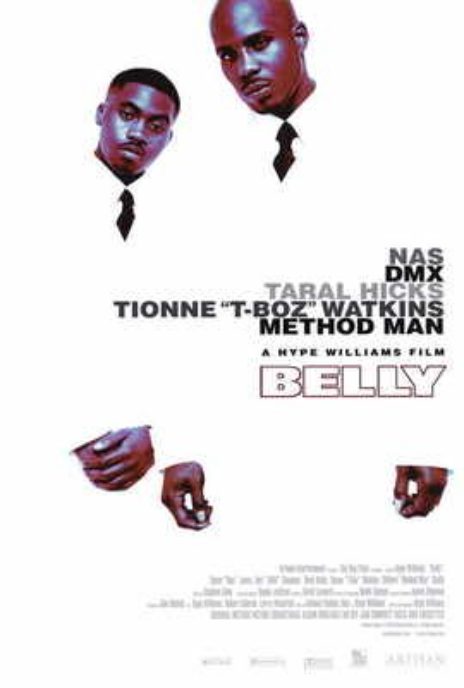
Despite what the critics of the New York Times have to say, Belly became a permanent cultural object. Twenty-eight years on it is quoted, sampled, referenced in videos, restored in 4K, and written about with more seriousness than most of the films that outgrossed it. Its wardrobe and its color grammar are still being copied by people who were not born when it came out. The film generated an enormous durable aesthetic externality, and the people who made it captured $9.6 million and stopped.
Everything else flowed to apparel economies who had nothing to do with the picture. The knitwear, the outerwear, the whole late-nineties iconography that Belly fixed in amber: that value went to brands who never wrote a check, never took a risk, and in most cases never knew. FUBU was on screens in that exact window, at $350 million in annual sales, and captured most of the film driven equity, because there was no structure through which a brand and a picture could be the same transaction.
In 1998 the distance between the frame and the cash register was a shopping mall and eighteen months, and no impulse survives that trip intact. The leak was less a law of nature, and more so, a latency problem, but the latency is now approximately zero, and nobody in this category has repriced anything to account for it. Belly holds a 13 percent critical score and has outlived essentially every film that beat it that season. Rotten Tomatoes measures whether critics enjoyed a movie in 1998, which turns out to be a poor proxy for whether anyone will still be dressing like it in 2026.
Belly’s rights sit at Lionsgate, which acquired Artisan in 2003. The two titles proposed here sit at two different studios, so the sidecar is not a relationship with one company, it is a repeatable instrument. Lionsgate is a library-forward company that has just come off Michael, which is to say it is currently very interested in the proposition that catalogue and music culture convert.
My recommendation would be to remake Belly with two rappers in the leading roles, cast it the way it was cast the first time. When Hype cast DMX, DMX was not a star. Jay-Z was the consensus choice and Hype was, in his own account, crucified for passing on him. DMX then owned 1998 outright. So the casting rule is not “get two famous rappers.” It is: put an established, reflective artist in the Sincere role and put someone six months from breaking in the Tommy role. Perhaps it’s Kendrick opposite an unproven volatile lead. The specific names are a casting exercise. The principle speaks for itself.
Hire a music video director, because that is what Belly is. The original was made by the best video director alive at the peak of his powers, and its entire value is in its images. Try to get Hiro Murai. It is the current equivalent of 1997 Hype: a director with a signature visual grammar, and an enormous native online audience. But if you don’t get Hiro, you have some great options out there.
who could assemble this
HarbourView Equity Partners is the natural underwriter. Founded in 2021 by Sherrese Clarke Soares, roughly $2.67 billion in regulatory assets under management as reported in 2025, more than seventy catalogs covering over thirty five thousand songs, backed at launch by Apollo, with KKR debt against the royalty holdings including a $500 million private securitization. In early 2023, Soares bid for BET against a three billion dollar ask.
A heritage mark underwrites like a catalog but behaves nothing like one. A catalog decays on an actuarial curve and the sponsor’s job is to slow the decline. A mark rusts, and the sponsor’s job is to reverse it. It would be the first asset in that book where the firm’s own cultural fluency, which is currently a sourcing advantage, becomes an operating one.
Byron Allen has the thesis and, right now, the question would be if he has the right balance sheet and patience for a project of this magnitude. He bid $3.5 billion for BET, $10 billion for Disney’s linear networks, and $30 billion including debt for Paramount, and closed none of them. Since 2025 he has been a net seller, retaining Moelis to sell twenty eight broadcast stations and closing $171 million of that with Gray Media in May 2026 to reduce debt. Allen remains the most credible strategic buyer of Black cultural media assets in the country.
Joe Budden is an interesting consideration, but definitely from wherever Bobby Abreu spent his career. The reason to reach for him is not because of the desire to tap his audience, but in a desire to tap his method. Mr. Budden and Ian Schwartzman built the Joe Budden Network to an estimated $20 million in annual revenue with no major distribution deal, no ad sales partnership, and no private equity, with roughly $12 million of it direct from more than 70,000 paying Patreon subscribers. Budden and Schwartzman turned down a $44 million offer that would have required removing content from YouTube, took Patreon equity instead of a guarantee, and recently launched their own membership platform rather than continuing to rent one. Budden and Schwartzman have repeatedly declined to trade ownership of their community for a check. This is the exact discipline this vehicle needs and the exact discipline the 2024 film deal lacked, and a partnership with that operating philosophy attached would produce something structurally unlike anything else in the category.
Beyond these, the capital base is family offices, which is where this kind of patient, control oriented, culturally specific money actually lives.
what the anchor is actually for
Everything to this point describes fixing one brand. That is the small version, but it is not the reason to do this. Reinvigorating FUBU The Collection, LLC is just the first step of what would be a much bigger vision. The true reason to pursue this is that a rehabilitated, cash-flowing, securitizable mark is a platform, and there is no American platform in this category.
There is one buyer of record for Black and streetwear cultural authority, and it is in Paris. Look at what LVMH has already done. LVMH hired Virgil Abloh to run Louis Vuitton menswear in 2018 and bought Off-White outright in 2021. It installed Nigo, the founder of A BATHING APE®, at KENZO Mode in 2022. It replaced Abloh with Pharrell Williams in 2023, meaning the two co-founders of Billionaire Boys Club & Ice Cream LLC now run menswear at two different LVMH houses. That is not a series of celebrity hires. That is a conglomerate systematically acquiring the scarcest input in luxury, which is cultural authorship it cannot generate internally, and it has been doing so almost entirely unopposed.
Meanwhile the supply side sits in the United States, fragmented and undercapitalized. There are a meaningful number of independent streetwear houses with genuine cultural equity, distinctive design leadership, and devoted secondary markets, and almost all of them share the same defect: they have no supply chain, no working capital, no wholesale infrastructure, and no ability to fulfill demand they have already created. Their constraint has never been taste. It is operations, and operations is the one thing capital can straightforwardly buy.
The condition of some of these major American fashion brands is similar to the condition of French fashion in the early 1980s. Bernard Arnault’s insight was never that he had better taste than the ateliers. It was that houses with immortal names and no operating discipline could be bought, given shared logistics, shared retail, shared media leverage and shared capital, and left creatively alone. HarbourView Equity Partners could emerge as the perfect holding company to own a narrative infrastructure, a library, a channel, and a package-stage wardrobe position that can deploy cultural re-entry for every house in the portfolio at marginal cost.
This category currently has very few bidders, the assets are cheap because they are operationally rather than creatively deficient, and there is currently nobody in America assembling them. Somebody eventually will, and they will need an anchor with contracted cash flow to do it, because that is the only way this has ever been done.